"How Modern Art Became Islamic"
Tuesday, February 24th, 4:45 PM
Goldwin Smith Hall, G22
Abstract
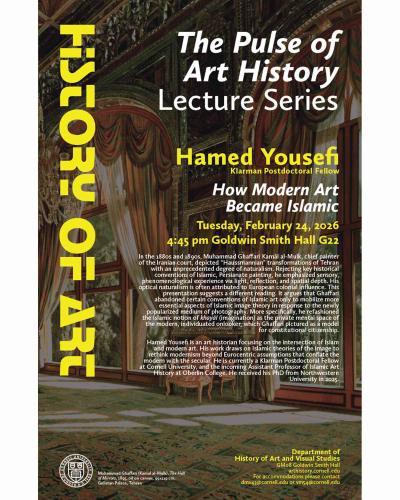
In the 1880s and 1890s, Muhammad Ghaffari Kamāl al-Mulk, chief painter of the Iranian court, depicted “Haussmannian” transformations of Tehran with an unprecedented degree of naturalism. Rejecting key historical conventions of Islamic, Persianate painting, he emphasized sensory, phenomenological experience via light, reflection, and spatial depth. His optical naturalism is often attributed to European colonial influence. This presentation suggests a different reading. It argues that Ghaffari abandoned certain conventions of Islamic art only to mobilize more essential aspects of Islamic image theory in response to the newly popularized medium of photography. More specifically, he refashioned the Islamic notion of khayāl (imagination) as the private mental space of the modern, individuated onlooker, which Ghaffari pictured as a model for constitutional citizenship.
Biography
Hamed Yousefi is an art historian focusing on the intersection of Islam and modern art. His work draws on Islamic theories of the image to rethink modernism beyond Eurocentric assumptions that conflate the modern with the secular. He is currently a Klarman Postdoctoral Fellow at Cornell University, and the incoming Assistant Professor of Islamic Art History at Oberlin College. He received his PhD from Northwestern University in 2025.