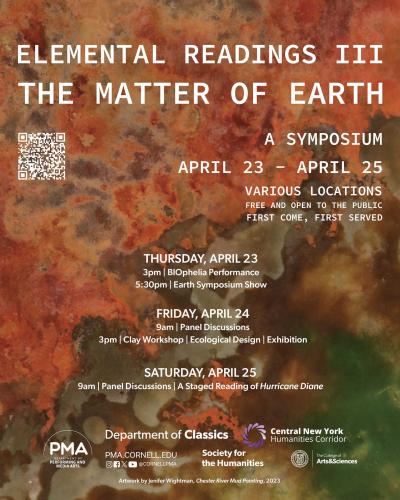
Join the Department of Performing and Media Arts and the Department of Classics for Elemental Readings III: The Matter of Earth, a symposium spanning four days and various locations from Thursday, April 23 through Saturday, April 25, and on Friday, May 1. See below for a complete list of events, including guest speakers, panel discussions, art exhibitions, workshops, and contributor abstracts. Free and open to the public. First-come, first-served.
Of all the ancient elements, earth holds most affective power. For Pliny the Elder, earth was “the element that is never angry with mankind”: in her capacity as our "mighty parent” or “mother”, Earth is embodied, personified and feminized; she nurtures us during life with all that she produces and receives our bodies in death, “even bearing our monuments and epitaphs and … extending our memory against the shortness of time.”
Yet Earth’s generosity also opens her to abuse, whether through violent extraction and pollution or fascist ideologies of “blood and soil.” As the element associated primarily with “matter,” earth provides the materials that make artistic expression possible, especially through the mediums of clay (from which humankind was itself crafted in many mythological traditions), stones, metals, and pigments. In dualist ontologies that denigrate ‘mere matter’ (in contrast to transcendent form, or intellect), terra is all too easily cast as territory, subject to measurement, ownership, conflict, and predation. Earth models and invites the most utopian of projects (co-constitutive visions of symbiosis and sustainability) but is also co-opted into the most dystopian and contested.
Our symposium explores these tensions across diverse periods, cultures, and media. Whilst classical antiquity’s relationship to earth (as mater and matter, as site of both nourishment and burial) plays a key role, contributions come from across the arts, humanities, and sciences, especially as they engage with both indigenous epistemologies and environmental studies.
This symposium is co-sponsored by the Department of Classics, Department of Performing and Media Arts, Society for the Humanities, and Central New York Humanities Corridor